Classifying Web Requests
HTTP requests — the ones a browser sends to a server. For access, deletion and opt-out requests sent by a person to a company, see Data subject rights.
A common task in web privacy measurements is to determine which web requests correspond to the benign loading of required web resources and which are used to track users. There are two main methods for such classification: matching requests against crowd-sourced lists (typically used in ad-blocking or tracking protection extensions) or using machine learning (ML) to classify the requests based on their context and request URL.
This page is dedicated to the classification of web requests and partially DOM elements on the loaded page. For classification of other resources, such as cookies, JavaScript code, or fingerprinting, navigate to the specific pages. What you drive the browser with is a separate decision, and it constrains this one: a classifier that needs the initiator chain or the script call stack needs a crawler that records them.
The one thing to understand before you start: in this field the filter list is both the instrument and the ground truth, and almost nobody separates the two. Of the 14 papers in this page's population that carry a learned request classifier, 8 take their labels from a filter list — including every reference baseline the field compares against (AdGraph, WebGraph, Khaleesi, WTAGRAPH, AdFlush, Duumviri). So “our classifier reaches 98% accuracy” usually means “our classifier agrees with EasyList 98% of the time”, and the residual is reported as error rather than as discovery.
We now know roughly what that costs. Calzavara et al. [1Calzavara, Stefano; Casarin, Samuele; Squarcina, Marco; Maffei, Matteo (2026): "From Syntactic Matching to Taint Tracking and Back: A Comparative Study of Web Tracking Detection Techniques", in: Proceedings on Privacy Enhancing Technologies. (Link)] (PoPETs 2026) ran syntactic filter-list matching and dynamic taint tracking over the same crawl and compared them request by request: of the 40,605 tracking requests found, syntactic matching found 33,584 and taint tracking 23,109, but only 16,088 were found by both. They then re-tested every one of those matches automatically, with a canary: replace the identifier in client-side storage with a fresh value, revisit the page, and see whether the new value shows up in a request matching the same template. If it does the match is confirmed; if the old value is still there instead, it is refuted. The estimate that comes out is 16%–19% likely false positives among the syntactic matches, rising to 27%–30% among the requests only syntactic matching flagged, against 4%–7% for the requests taint tracking found — and 7,021 requests, around 17% of the dataset, were found by taint tracking alone. Treat a filter-list hit as a noisy label with error bars in the high teens, not as a definition — and say in your paper that you did. That said, this is one study, one taint-tracking browser, 7,614 sites; nobody has repeated it, and Open Questions says so.
What to Read First
SoK: Advances and Open Problems in Web Tracking [
2Vekaria, Yash; Beugin, Yohan; Munir, Shaoor; Acar, Gunes; Bielova, Nataliia; Englehardt, Steven; Iqbal, Umar; Kapravelos, Alexandros; Laperdrix, Pierre; Nikiforakis, Nick; Polakis, Jason; Roesner, Franziska; Shafiq, Zubair; Zimmeck, Sebastian (2025): "SoK: Advances and Open Problems in Web Tracking". arXiv preprint arXiv:2506.14057. (Link)] — a systematisation by
fourteen of the field's authors, and the fastest orientation to where request classification sits in the wider tracking literature. Its §V-C1 gives the same three-limitation account of filter lists this page gives (small maintainer community, accumulated dead rules, static so evadable) and then names the
ML lineage: AutoFR, AdGraph, WebGraph, WTAGraph, and PageGraph as the shipped implementation.
It is still a preprint: only v1 exists (16 June 2025), and the version exhibited as a poster at IEEE S&P 2026 labels itself “Preprint”.
1) Check for a venue version before you cite it as published.
SoK: After Decades of Web Tracker Detection, What's Next? [
3Rieder, Wolf; Raschke, Philip; Cory, Thomas; Sechting, Christian René; Kumar, Aditya; Küpper, Axel (2026): "SoK: After Decades of Web Tracker Detection, What's Next?", in: Proceedings of the IEEE Symposium on Security and Privacy. (Link)], IEEE S&P 2026 — a meta-study specifically of tracker
detectors, which is the classifier lineage this page is about.
Then read in this order, because each one answers the previous one's complaint: filter lists as measured dead weight [
4Snyder, Peter; Vastel, Antoine; Livshits, Ben (2020): "Who Filters the Filters: Understanding the Growth, Usefulness and Efficiency of Crowdsourced Ad Blocking", Proc. ACM Meas. Anal. Comput. Syst. 4(2). (DOI) (Link)] → what they miss [
5Fouad, Imane; Bielova, Nataliia; Legout, Arnaud; Sarafijanovic-Djukic, Natasa (2020): "Missed by Filter Lists: Detecting Unknown Third-Party Trackers with Invisible Pixels", in: Proceedings on Privacy Enhancing Technologies, pp. 499-518. (DOI)] → the graph lineage [
6Iqbal, Umar; Snyder, Peter; Zhu, Shitong; Livshits, Benjamin; Qian, Zhiyun; Shafiq, Zubair (2020): "AdGraph: A Graph-Based Approach to Ad and Tracker Blocking", in: 2020 IEEE Symposium on Security and Privacy (SP), pp. 763-776. (DOI)], [
7Siby, Sandra; Iqbal, Umar; Englehardt, Steven; Shafiq, Zubair; Troncoso, Carmela (2022): "WebGraph: Capturing Advertising and Tracking Information Flows for Robust Blocking", in: 31st USENIX Security Symposium (USENIX Security 22), pp. 2875-2892. USENIX Association, Boston, MA. (Link)] → mixed resources [
8Amjad, Abdul Haddi; Saleem, Danial; Gulzar, Muhammad Ali; Shafiq, Zubair; Zaffar, Fareed (2021): "TrackerSift: untangling mixed tracking and functional web resources", in: Proceedings of the ACM Internet Measurement Conference. (DOI)] → the deployable classifier [
9Lee, Kiho; Lim, Chaejin; Jin, Beomjin; Kim, Taeyoung; Kim, Hyoungshick (2024): "AdFlush: A Real-World Deployable Machine Learning Solution for Effective Advertisement and Web Tracker Prevention", in: Proceedings of the ACM Web Conference. (DOI)] → labels that at least come with a breakage check [
10Shuang, He; Zhao, Lianying; Lie, David (2025): "Duumviri: Detecting Trackers and Mixed Trackers with a Breakage Detector", in: Proceedings of the Network and Distributed System Security Symposium. (Link)] → how wrong the list was all along [
1Calzavara, Stefano; Casarin, Samuele; Squarcina, Marco; Maffei, Matteo (2026): "From Syntactic Matching to Taint Tracking and Back: A Comparative Study of Web Tracking Detection Techniques", in: Proceedings on Privacy Enhancing Technologies. (Link)].
Pick the Unit Before You Pick the Method
“Which requests are tracking” hides a choice of unit, and the units are not interchangeable. Papers that appear to disagree about tracking prevalence are often measuring different rows of this table.
| Unit | What you get | What it costs |
| eTLD+1 / domain | The cheapest unit, and the only one a hosts-file or DNS blocklist can give you. Comparable across papers | Cannot distinguish cdn.example.com/jquery.js from cdn.example.com/track.gif; CNAME cloaking and first-party proxying defeat it [11Dimova, Yana; Acar, Gunes; Olejnik, Lukasz; Joosen, Wouter; Van Goethem, Tom (2021): "The CNAME of the game: Large-scale analysis of DNS-based tracking evasion", Proceedings on Privacy Enhancing Technologies 2021:394–412. (DOI) (Link)] |
| entity / company | The unit the question usually wants: google.com, googleapis.com and doubleclick.net are one organisation, so an eTLD+1 “third party” label is wrong for same-org domains | Needs an entity map. Disconnect's entities.json and DuckDuckGo Tracker Radar's entity-to-domain map are the two the field uses, and they disagree; whichever you pick, name it |
| request URL | What Adblock-syntax lists actually match on, with resource type and party as modifiers | A tracker that rotates paths or moves to a first-party subdomain escapes; blocked replica ad domains survived a mean 410.5 days before a rule appeared — see below |
| script / resource | Attributes the request to the code that made it | ~13.4% of scripts are mixed — they do tracking and functionality in the same file [12Amjad, Abdul Haddi; Munir, Shaoor; Shafiq, Zubair; Gulzar, Muhammad Ali (2024): "Blocking Tracking JavaScript at the Function Granularity", in: Proceedings of the ACM SIGSAC Conference on Computer and Communications Security. (DOI)] |
| request chain | Catches trackers that only appear downstream of a redirect | Needs the initiator chain recorded; roughly one third of requests in a crawl are in a chain [13Iqbal, Umar; Wolfe, Charlie; Nguyen, Charles; Englehardt, Steven; Shafiq, Zubair (2022): "Khaleesi: Breaker of Advertising and Tracking Request Chains", in: 31st USENIX Security Symposium (USENIX Security 22), pp. 2911-2928. USENIX Association, Boston, MA. (Link)] |
| function / method | The finest granularity anyone has published | Needs a patched browser, and is a JavaScript question as much as a request one |
| URL parameter | Catches identifiers passed in link decoration that survive third-party cookie blocking | A different classifier and a different list — see Link Decoration and Tracking Parameters |
Mixed resources are the normal case, not the tail. TrackerSift [8Amjad, Abdul Haddi; Saleem, Danial; Gulzar, Muhammad Ali; Shafiq, Zubair; Zaffar, Fareed (2021): "TrackerSift: untangling mixed tracking and functional web resources", in: Proceedings of the ACM Internet Measurement Conference. (DOI)] measured how far up the granularity ladder you have to go before a resource is purely one or the other: more than 17% of domains, 48% of hostnames, 6% of scripts and 9% of methods in their crawls combine tracking and functional behaviour. Blocking at the hostname level therefore breaks things, and 9 of their 10 manually inspected sites showed major or minor breakage when mixed scripts were blocked. Whatever unit you pick, say what you did with the mixed cases; “we blocked the domain” is a decision with a measurable cost.
Methods, and Which Ones Are Current
A ranking of what the 2010–2026 literature did is a fact about the literature, not advice about what to do now. The table below dates each method and states its status as of 2026-08-12. Our corpus reaches 2026 but its 2025–2026 venue-years are provisional (CCS and IMC 2026 have not been held; IEEE S&P and WWW 2026 are incompletely selected), so current rows were checked against work outside the corpus as well.
| Era | Method | Representative work | Status in 2026 |
| 2010– | Adblock-syntax filter lists, applied live or in post-processing | EasyList, EasyPrivacy, Disconnect | Current, and still the default. It is more than half again as common as anything else in the corpus section below. Not because it is best but because it is comparable, free and reviewable |
| 2015–2019 | Supervised classifiers on URL and content features | One-class learning on tracker URLs [14Ikram, Muhammad; Asghar, Hassan Jameel; Kaafar, Mohamed Ali; Mahanti, Anirban; Krishnamurthy, Balachander (2017): "Towards Seamless Tracking-Free Web: Improved Detection of Trackers via One-class Learning", in: Proceedings on Privacy Enhancing Technologies. (DOI)] | Superseded. Content features are attacker-controlled; WebGraph's evasion experiment is the demonstration |
| 2017–2021 | Anti-adblock and circumvention detection as its own task | The ad wars [15Iqbal, Umar; Shafiq, Zubair; Qian, Zhiyun (2017): "The ad wars: retrospective measurement and analysis of anti-adblock filter lists", in: Proceedings of the ACM Internet Measurement Conference. (DOI)], anti-adblock detection [16Mughees, Muhammad Haris; Qian, Zhiyun; Shafiq, Zubair (2017): "Detecting Anti Ad-blockers in the Wild", in: Proceedings on Privacy Enhancing Technologies, pp. 130-146. (DOI)], CV-Inspector [17Le, Hieu; Markopoulou, Athina; Shafiq, Zubair (2021): "CV-Inspector: Towards Automating Detection of Adblock Circumvention", in: Proceedings of the Network and Distributed System Security Symposium. (Link)] | Alive but niche. CV-Inspector reached 93% accuracy on sites that successfully circumvent adblockers, and found that over a third of sites with relevant rules in the Anti-Circumvention Filter List still circumvented |
| 2020–2022 | Graph representations of page execution, ML-classified | AdGraph [6Iqbal, Umar; Snyder, Peter; Zhu, Shitong; Livshits, Benjamin; Qian, Zhiyun; Shafiq, Zubair (2020): "AdGraph: A Graph-Based Approach to Ad and Tracker Blocking", in: 2020 IEEE Symposium on Security and Privacy (SP), pp. 763-776. (DOI)] (95.33% accuracy), WebGraph [7Siby, Sandra; Iqbal, Umar; Englehardt, Steven; Shafiq, Zubair; Troncoso, Carmela (2022): "WebGraph: Capturing Advertising and Tracking Information Flows for Robust Blocking", in: 31st USENIX Security Symposium (USENIX Security 22), pp. 2875-2892. USENIX Association, Boston, MA. (Link)] (94.32% accuracy), WTAGRAPH [18Yang, Zhiju; Pei, Weiping; Chen, Monchu; Yue, Chuan (2022): "WTAGRAPH: Web Tracking and Advertising Detection using Graph Neural Networks", in: Proceedings of the IEEE Symposium on Security and Privacy. (DOI)] (97.90%) | The reference baselines — every later paper compares against them. Treat them as baselines to beat, not as tools to install |
| 2020–2022 | Request chains as the unit, sequential ML | Khaleesi [13Iqbal, Umar; Wolfe, Charlie; Nguyen, Charles; Englehardt, Steven; Shafiq, Zubair (2022): "Khaleesi: Breaker of Advertising and Tracking Request Chains", in: 31st USENIX Security Symposium (USENIX Security 22), pp. 2911-2928. USENIX Association, Boston, MA. (Link)] (94.07% on a later crawl) | Still a cited baseline. It is not a page-execution graph; do not lump it with AdGraph |
| 2021–2023 | Rule generation rather than rule matching: learn the filter rules themselves | AutoFR [19Le, Hieu; Elmalaki, Salma; Markopoulou, Athina; Shafiq, Zubair (2023): "AutoFR: Automated Filter Rule Generation for Adblocking", in: Proceedings of the USENIX Security Symposium. (Link)], regional list generation [20Sjösten, Alexander; Snyder, Peter; Pastor, Antonio; Papadopoulos, Panagiotis; Livshits, Benjamin (2020): "Filter List Generation for Underserved Regions", in: Proceedings of the ACM Web Conference. (DOI)] | Current, and under-used in measurement. AutoFR's generated rules blocked 86% of ads against EasyList's 87%, within its breakage threshold |
| 2021 | Surrogate replacement instead of blocking, to avoid breakage | SugarCoat [21Smith, Michael; Snyder, Peter; Livshits, Benjamin; Stefan, Deian (2021): "SugarCoat: Programmatically Generating Privacy-Preserving, Web-Compatible Resource Replacements for Content Blocking", in: Proceedings of the ACM SIGSAC Conference on Computer and Communications Security. (DOI)] | Current, and a Brave collaboration rather than a research prototype.2) Mean breakage rating 1.03 (normal) versus 2.86 when the same scripts were blocked outright |
| 2023–2024 | Deployability as the objective: small feature sets, no content features | AdFlush [9Lee, Kiho; Lim, Chaejin; Jin, Beomjin; Kim, Taeyoung; Kim, Hyoungshick (2024): "AdFlush: A Real-World Deployable Machine Learning Solution for Effective Advertisement and Web Tracker Prevention", in: Proceedings of the ACM Web Conference. (DOI)] | Current. F1 0.98 against AdGraph 0.93, WebGraph 0.90, WTAGraph 0.84; F1 stayed above 0.9789 for five and a half months without retraining |
| 2024 | Function granularity with dynamic calling context | NoT.js [12Amjad, Abdul Haddi; Munir, Shaoor; Shafiq, Zubair; Gulzar, Muhammad Ali (2024): "Blocking Tracking JavaScript at the Function Granularity", in: Proceedings of the ACM SIGSAC Conference on Computer and Communications Security. (DOI)] | Current, and mostly a JavaScript method |
| 2024 | Link-decoration classification — the parameter, not the request | PURL [22Munir, Shaoor; Lee, Patrick; Iqbal, Umar; Shafiq, Zubair; Siby, Sandra (2024): "PURL: Safe and Effective Sanitization of Link Decoration", in: 33rd USENIX Security Symposium (USENIX Security 24), pp. 4103-4120. USENIX Association, Philadelphia, PA. (Link)] | Current, and the growth area. See Link Decoration and Tracking Parameters |
| 2025 | Response headers rather than request features, for cross-browser transfer | Beyond the Request [23Rieder, Wolf; Raschke, Philip; Cory, Thomas (2025): "Beyond the Request: Harnessing HTTP Response Headers for Cross-Browser Web Tracker Detection in an Imbalanced Setting", in: Proceedings on Privacy Enhancing Technologies, pp. 100-117. (DOI)] | Current, and the honest negative result in it matters: classifiers trained on Chrome and Firefox degraded substantially on Brave |
| 2025 | Differential features plus a breakage detector — block the request field, measure how the page changes | Duumviri [10Shuang, He; Zhao, Lianying; Lie, David (2025): "Duumviri: Detecting Trackers and Mixed Trackers with a Breakage Detector", in: Proceedings of the Network and Distributed System Security Symposium. (Link)] | Current, and the most interesting direction. Its features are behavioural rather than drawn from the labelled artefact, and a separate breakage detector catches functional requests the lists mislabel. It reproduces filter-list labels at 97.44% and found 22 previously unreported trackers. Note it still trains on EasyList and EasyPrivacy labels |
| 2026 | Taint tracking as a cross-check on syntactic matching | Calzavara et al. [1Calzavara, Stefano; Casarin, Samuele; Squarcina, Marco; Maffei, Matteo (2026): "From Syntactic Matching to Taint Tracking and Back: A Comparative Study of Web Tracking Detection Techniques", in: Proceedings on Privacy Enhancing Technologies. (Link)] | Read this before choosing between the two. It is the measurement of how much your filter list is wrong by |
| 2026 | LLM-assisted annotation feeding a graph classifier | TGNN [24Xiong, Shenping; Wang, Xutong; Jin, Ze; Liu, Xinyu; Wang, Haoqiang; Chen, Zhen; Tan, Ru; Liu, Qixu (2026): "TGNN: Enhancing Pixel Tracking Detection via LLM-driven Annotation and GAT-powered Structural Representation", in: Proceedings of the ACM Web Conference. (DOI)] | Emerging. Exactly one paper in this corpus classifies web requests with an LLM, and it uses the model to label training data (F1 98.17% against expert labels), not to classify at inference |
What is genuinely superseded
What the corpus cannot tell you
LLM classification of web requests is, as of 2026-08-12, essentially absent from the peer-reviewed literature. One paper in these seven venues, TGNN [24Xiong, Shenping; Wang, Xutong; Jin, Ze; Liu, Xinyu; Wang, Haoqiang; Chen, Zhen; Tan, Ru; Liu, Qixu (2026): "TGNN: Enhancing Pixel Tracking Detection via LLM-driven Annotation and GAT-powered Structural Representation", in: Proceedings of the ACM Web Conference. (DOI)] (TheWebConf 2026), carries an llm method on a web-request classification tuple, and it uses the model to annotate training data rather than to classify at inference. A targeted search outside the corpus — arXiv, EuroS&P, ACSAC, RAID, AsiaCCS and WPES, 2025–2026 — found no peer-reviewed paper that prompts or fine-tunes a language model to decide whether an HTTP request is tracking. Industry is ahead of the literature here and says so: AdGuard demonstrated a prototype at the Ad-Filtering Dev Summit in October 2025 that asks a model per resource instead of consulting a list, and reported latency and cost as the blockers.3) If you are planning an LLM-based request classifier you are not late — but you have no baseline to cite, so budget for building one, and for the reviewer question about cost, reproducibility and prompt drift that this page cannot answer for you.
And one 2026 paper is missing from the tables below by construction. AdVersa [27Lim, Chaejin; Lee, Kiho; Jin, Beomjin; Baek, Heewon; Kim, Hyoungshick (2026): "AdVersa: Adversarially-Robust and Practical Ad and Tracker Blocking in the Wild", in: Proceedings of the ACM Web Conference, pp. 3519-3530. (DOI)] (TheWebConf 2026) reports F1 98.23%, generalisation to unseen domains at 91.47% F1, and robustness where prior systems were evaded 57–92% of the time. TheWebConf 2026 is one of the incompletely-selected venue-years, so it is absent from every corpus figure on this page even though it is squarely in scope. Its own abstract frames it as embedding-based rather than LLM-based; treat it as the likeliest successor to the AdGraph/WebGraph line and not as the missing LLM baseline. Its figures here are the paper's own, taken from its abstract and Crossref record; nobody on this page has read it critically.
Block Lists
Matching a request against an Adblock-syntax filter list is what 57.0% of the papers below do, and it is still the default. What it means to do that well — which lists exist and which are dead, how to record the exact version and commit you matched against, which engine to use, what a rule needs from your crawl in order to be evaluated at all, what the list misses and where, and why “on the list” is a definition rather than a finding — is one topic and it now has its own page:
The three things from it you cannot skip while reading this page:
A rule is evaluated against a request in context. $third-party,
$domain=, the resource-type options and
@@ exception rules all need the initiator
URL, the resource type and the redirect chain. A crawl that logged only request URLs cannot be post-processed with a list, and it fails silently rather than erroring.
The list is a moving target. EasyList publishes a
Version: and a
Commit: in its own header and changes several times an hour; of the corpus papers naming a list as a tool,
four record something that identifies the rules they matched against (
the count and its denominator).
A filter-list hit is a noisy label, estimated at
16%–19% false positives [
1Calzavara, Stefano; Casarin, Samuele; Squarcina, Marco; Maffei, Matteo (2026): "From Syntactic Matching to Taint Tracking and Back: A Comparative Study of Web Tracking Detection Techniques", in: Proceedings on Privacy Enhancing Technologies. (Link)], with the false negatives measured repeatedly and separately — 25.22% [
5Fouad, Imane; Bielova, Nataliia; Legout, Arnaud; Sarafijanovic-Djukic, Natasa (2020): "Missed by Filter Lists: Detecting Unknown Third-Party Trackers with Invisible Pixels", in: Proceedings on Privacy Enhancing Technologies, pp. 499-518. (DOI)], 34.5% [
28Lee, Dongkeun; Joo, Minwoo; Lee, Wonjun (2023): "Net-track: Generic Web Tracking Detection Using Packet Metadata", in: Proceedings of the ACM Web Conference. (DOI)], and much worse off the desktop web.
ML Classification
Filter lists ship to users; learned classifiers, with one partial exception, do not. Three reasons, and all three matter for how you read the results below:
None of that stops you using a learned classifier as a measurement instrument, which is what this section is for. But read the three subsections below as the field's historical baselines, not as recommendations: the systems this page calls current are in What Came After, and Why It Matters.
These are baselines, not tools. Every model below was trained on one crawl of one browser from one vantage point, against filter-list labels of one vintage. Beyond the Request [23Rieder, Wolf; Raschke, Philip; Cory, Thomas (2025): "Beyond the Request: Harnessing HTTP Response Headers for Cross-Browser Web Tracker Detection in an Imbalanced Setting", in: Proceedings on Privacy Enhancing Technologies, pp. 100-117. (DOI)] is the paper to read on what that costs: its classifiers reached ROC-AUC, AUPRC and F1 above 0.93 on Chrome and Firefox and degraded substantially on Brave — the same task, a different browser. If you download a published model and apply it to your crawl, you have changed the distribution and you owe the reviewer a validation on your own data.
AdGraph
AdGraph: A Graph-Based Approach to Ad and Tracker Blocking [6Iqbal, Umar; Snyder, Peter; Zhu, Shitong; Livshits, Benjamin; Qian, Zhiyun; Shafiq, Zubair (2020): "AdGraph: A Graph-Based Approach to Ad and Tracker Blocking", in: 2020 IEEE Symposium on Security and Privacy (SP), pp. 763-776. (DOI)] uses ML classification based on EasyList lists. It constructs a graph structure of web elements, network requests, and JavaScript execution for feature extraction. Example features include graph size, node degree, request length, domain party, and the presence of advertising keywords in requests. A random forest model achieves 95.33% accuracy, 89.1% precision and 86.6% recall against labels derived from eight crowdsourced filter lists, as shown below. Its breakage was on par with the lists themselves: no breakage on 85.0% of sites against the lists' 88.6%, major breakage on 5.9% against 6.4%.
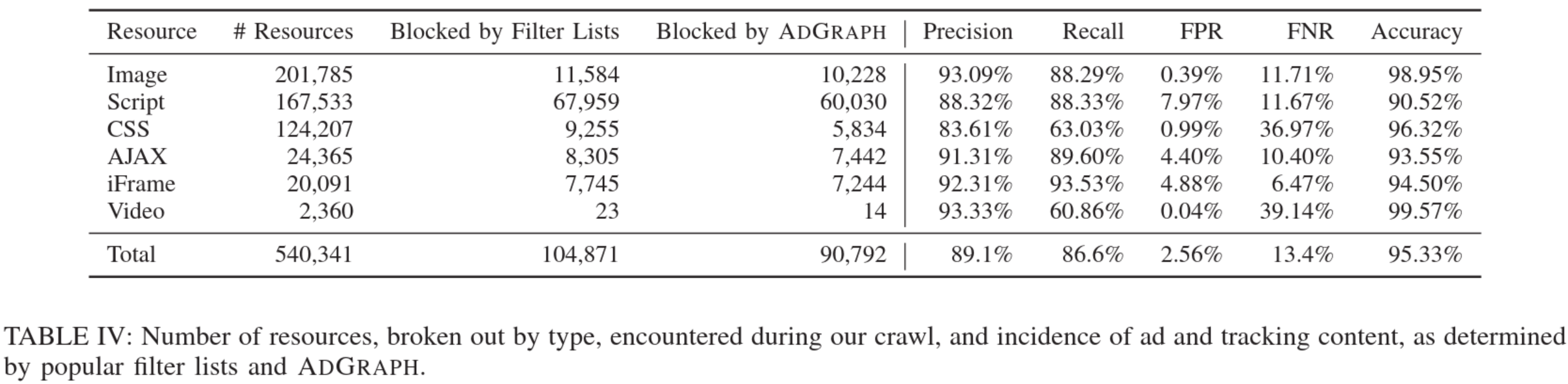
ML performance of AdGraph on various lists according to [6Iqbal, Umar; Snyder, Peter; Zhu, Shitong; Livshits, Benjamin; Qian, Zhiyun; Shafiq, Zubair (2020): "AdGraph: A Graph-Based Approach to Ad and Tracker Blocking", in: 2020 IEEE Symposium on Security and Privacy (SP), pp. 763-776. (DOI)].
Repository with instrumented crawler. Its production successor is Brave's PageGraph, which is the practical way to get this representation today.
WebGraph
WebGraph: Capturing Advertising and Tracking Information Flows for Robust Blocking [7Siby, Sandra; Iqbal, Umar; Englehardt, Steven; Shafiq, Zubair; Troncoso, Carmela (2022): "WebGraph: Capturing Advertising and Tracking Information Flows for Robust Blocking", in: 31st USENIX Security Symposium (USENIX Security 22), pp. 2875-2892. USENIX Association, Boston, MA. (Link)] is a follow-up to AdGraph. It improves feature processing to address adversarial ML methods, removes dependency on modifiable content features, and enhances overall performance: 94.32 ± 0.27% accuracy with content features removed, and the robustness result that justifies the design — a URL-mutating adversary with first-party collusion succeeded 96.62 ± 0.37% of the time against AdGraph and 8.34 ± 0.66% against WebGraph.
Repository with trained model and pipeline
Khaleesi
Khaleesi: Breaker of Advertising and Tracking Request Chains [13Iqbal, Umar; Wolfe, Charlie; Nguyen, Charles; Englehardt, Steven; Shafiq, Zubair (2022): "Khaleesi: Breaker of Advertising and Tracking Request Chains", in: 31st USENIX Security Symposium (USENIX Security 22), pp. 2911-2928. USENIX Association, Boston, MA. (Link)] also extends AdGraph, but changes the unit: it classifies request chains, which accounted for about one third of all requests in its crawls, reaching 94.07% accuracy on a later dataset than it was trained on. Here is a repository with trained model and pipeline.
Additionally, it offers a Firefox extension that blocks advertising chains. While not directly suitable for crawls (the current implementation blocks requests), you can disable the functionality by removing the return { cancel: true } at background.js lines 51–54 (checked 2026-08-12: line 52 is the log, 53 is the cancel) and collect logs to classify ads instead.
What Came After, and Why It Matters
| System | Unit and signal | Headline result | Why you would use it |
| WTAGRAPH [18Yang, Zhiju; Pei, Weiping; Chen, Monchu; Yue, Chuan (2022): "WTAGRAPH: Web Tracking and Advertising Detection using Graph Neural Networks", in: Proceedings of the IEEE Symposium on Security and Privacy. (DOI)], IEEE S&P 2022 | Graph neural network over the whole page graph | 97.90% accuracy; 266 ms per page; evasion 0.22–3.11% | The GNN formulation of the same idea; a baseline AdFlush beats |
| Net-track [28Lee, Dongkeun; Joo, Minwoo; Lee, Wonjun (2023): "Net-track: Generic Web Tracking Detection Using Packet Metadata", in: Proceedings of the ACM Web Conference. (DOI)], TheWebConf 2023 | Packet metadata only — no browser instrumentation | 94.02% accuracy; still above 93% on partial traces | The only option when you cannot instrument the client at all (middlebox, router, encrypted DNS setting) |
| AdFlush [9Lee, Kiho; Lim, Chaejin; Jin, Beomjin; Kim, Taeyoung; Kim, Hyoungshick (2024): "AdFlush: A Real-World Deployable Machine Learning Solution for Effective Advertisement and Web Tracker Prevention", in: Proceedings of the ACM Web Conference. (DOI)], TheWebConf 2024 | 27 features selected from 883, no content features | F1 0.98 vs AdGraph 0.93 / WebGraph 0.90 / WTAGraph 0.84; F1 > 0.9789 over five and a half months without retraining; F1 > 0.93 on all 14 HTTP request types | The strongest current baseline, and the one that reports longitudinal stability |
| Beyond the Request [23Rieder, Wolf; Raschke, Philip; Cory, Thomas (2025): "Beyond the Request: Harnessing HTTP Response Headers for Cross-Browser Web Tracker Detection in an Imbalanced Setting", in: Proceedings on Privacy Enhancing Technologies, pp. 100-117. (DOI)], PETS 2025 | HTTP response headers, imbalanced-setting evaluation | ROC-AUC, AUPRC and F1 above 0.93; Chrome/Firefox transfer well, Brave does not | Read for the cross-browser negative result and the imbalanced-data methodology; trackers were ≈0.26–0.5% of responses in their datasets |
| Duumviri [10Shuang, He; Zhao, Lianying; Lie, David (2025): "Duumviri: Detecting Trackers and Mixed Trackers with a Breakage Detector", in: Proceedings of the Network and Distributed System Security Symposium. (Link)], NDSS 2025 | Differential features at the request-field level, plus a breakage detector | 97.44% agreement with filter-list labels on 53,217 requests; 95.39% on mixed responses; 74.19% lower bound on mixed fields; 22 new trackers | The most promising partial answer to the circularity: it still trains on EasyList/EasyPrivacy labels, but its features come from experimentally blocking the field and watching the page, so a disagreement is evidence about the page rather than about the URL string |
| TGNN [24Xiong, Shenping; Wang, Xutong; Jin, Ze; Liu, Xinyu; Wang, Haoqiang; Chen, Zhen; Tan, Ru; Liu, Qixu (2026): "TGNN: Enhancing Pixel Tracking Detection via LLM-driven Annotation and GAT-powered Structural Representation", in: Proceedings of the ACM Web Conference. (DOI)], TheWebConf 2026 | Graph attention network, LLM-annotated training data | F1 92.24% connected / 84.49% isolated requests; annotation F1 98.17%; pixel tracking on at least 16.74% of distinct domains | The only LLM-touching request classifier in this corpus; read it for the annotation pipeline |
Link Decoration and Tracking Parameters
As third-party cookies disappear, identifiers move into the URL. Link decoration is the practice of appending information to a link — ?fbclid=…, ?gclid=…, ?utm_source=… — so that the destination site, or a script on it, can recover an identifier without any cross-site storage. Classifying decorations is a different problem from classifying requests: the request may be entirely legitimate and only one query parameter privacy-relevant, so blocking is the wrong response and sanitising is the right one.
PURL (Privacy-preserving URL) [22Munir, Shaoor; Lee, Patrick; Iqbal, Umar; Shafiq, Zubair; Siby, Sandra (2024): "PURL: Safe and Effective Sanitization of Link Decoration", in: 33rd USENIX Security Symposium (USENIX Security 24), pp. 4103-4120. USENIX Association, Philadelphia, PA. (Link)], USENIX Security 2024, is the reference work.
Method. It builds a page-execution graph that also has
decoration nodes, so a decoration can be linked to the storage value it came from and the script that put it there. Encoded values are matched by monitoring Base64, MD5, SHA-1 and SHA-256 encodings of storage values, which is how a hashed cookie in a
URL is caught. A random forest is then trained on labels combining filter lists, Cookiepedia and manually curated tracking-parameter lists.
Prevalence. 73.02% of tested sites use link decoration for tracking, with an average of 10.75 tracking decorations per site. Those are the numbers to cite for “how common is this”.
Performance and cost. 98.74% accuracy, 98.62% precision, 98.87% recall. Sanitising rather than blocking keeps breakage low: minor breakage on 5 of 100 sites and major breakage on 1 (a
CSS load failure).
The result that connects this page to fingerprinting. Fingerprinting scripts initiated requests carrying
1,800 unique decorations, of which 200 were labelled as advertising or tracking — decoration is one of the ways a fingerprint leaves the page.
The experiment worth copying. They ran crawls with and without entering deterministic identifiers (email addresses, names) and found 538 decorations present only in the identifier crawls, 62 of them tracking. That differential design isolates identifier exfiltration from ordinary parameters far better than any static list, and it is cheap.
The lists, if you do not want to train a classifier. Parameter-stripping rules are maintained by browser vendors rather than by the filter-list community, and they are not equally accessible. Checked 2026-08-12:
| Source | Where the machine-readable list is | Notes |
| AdGuard URL Tracking filter | https://filters.adtidy.org/windows/filters/17.txt (also per-platform) | The best starting point. Adblock syntax with $removeparam; header carries Version: 2.0.13.86, TimeUpdated: 2026-08-12T12:22:16+00:00, Expires: 12 hours |
uBlock Origin $removeparam | Not a separate list: an option used inside its subscribed lists, incl. AdGuard's above. Which lists ship is in uAssets | Cite the underlying list, not “uBlock” |
| Brave debouncing | brave-lists/debounce.json in brave/adblock-lists | JSON, typed rules (redirect, base64,redirect, regex-path). Solves a related problem — bounce-through redirectors — not parameter stripping |
| Firefox query stripping | Not in a repository — it is a Remote Settings collection, read at runtime by nsIUrlQueryStrippingListService. Fetch it directly: https://firefox.settings.services.mozilla.com/v1/buckets/main/collections/query-stripping/records returns the stripList and allowList as JSON, no auth. Local override prefs are privacy.query_stripping.strip_list / .allow_list | Much shorter than the others: 3 records, 23 stripped parameters and 1 allow-listed host on 2026-08-12 (gclid, fbclid, msclkid, mc_eid, mkt_tok …). If you are comparing coverage, Firefox is not trying to do the same job as AdGuard's 2,492-rule filter |
| ClearURLs rules | ClearURLs/Rules | Rules data still updated (last push 2026-03-25); the extension itself has not been pushed since 2025-07-27 and a fork, Linkumori, positions itself as the maintained MV3 successor. Verify the extension's status yourself before treating it as live |
Nobody has published a coverage-and-accuracy comparison of these parameter lists against each other, in the way Vallina et al. did for website categorisation services. PURL's own labels came from a union of them plus manual curation, which means the union has never been independently audited. This is a well-scoped, publishable measurement.
Cookie Notices and Their Interactive Elements
Finding the notice and labelling its buttons is a classification problem on DOM elements, and it is on this page because the methods are the same ones — a CSS-selector list, then a heuristic, then a small language model. What the notice means legally, and what to do about consent, is on Granting Consent to Websites; the crawler-side mechanics of clicking are on Interaction.
The pipeline everyone converges on has three stages, and each has a measured cost.
Find the notice. Start with the
EasyList Cookie List CSS selectors (
current rule counts here — it is overwhelmingly cosmetic, which is what you want for finding a banner) and add
DOM/text heuristics: high
z-index,
position: fixed, a privacy-related keyword pool, a container that overlaps the viewport bottom or centre.
Label the interactive elements. Accept / reject / close / save / settings / other. Button text is short, multilingual and adversarially designed, which is why this is the stage that moved from keyword lists to learned models.
Decide what to click, and verify it happened. A click that silently fails is worse than no click, because the crawl continues and reports pre-consent behaviour as post-consent. The consent-interaction crawlers the field shares for this — BannerClick, Priv-Accept and the
autoconsent integration built into
Tracker Radar Collector — are compared on
the crawler page.
| Study | Stage 1 method | Stage 2 method | Reported performance |
| Matte et al. [29Matte, Célestin; Bielova, Nataliia; Santos, Cristiana Teixeira (2020): "Do Cookie Banners Respect my Choice? Measuring Legal Compliance of Banners from IAB Europe's Transparency and Consent Framework", in: Proceedings of the IEEE Symposium on Security and Privacy. (DOI)], IEEE S&P 2020 | Presence of the TCF \_\_cmp() API | — | Found a TCF banner on 1,426 of 22,949 sites (6.2%); a CMP API is a precise but narrow detector |
| Rasaii et al. [30Rasaii, Ali; Gosain, Devashish; Gasser, Oliver (2023): "Thou Shalt Not Reject: Analyzing Accept-Or-Pay Cookie Banners on the Web", in: Proceedings of the ACM Internet Measurement Conference. (DOI)], IMC 2023 | Word-and-currency heuristic for cookiewalls | — | 98.2% precision on the detected set; cookiewalls on 280 of the ~45k sites crawled (0.6%) |
| Khandelwal et al. [31Khandelwal, Rishabh; Nayak, Asmit; Harkous, Hamza; Fawaz, Kassem (2023): "Automated Cookie Notice Analysis and Enforcement", in: 32nd USENIX Security Symposium (USENIX Security 23), pp. 1109-1126. USENIX Association, Anaheim, CA. (Link)], USENIX Sec 2023 (CookieEnforcer) | Candidate-element extraction, then BERT | T5-Large predicting the click sequence | 986 of 2,000 domains, 2 false positives and 16 false negatives; 93.7% end-to-end on 1,000 sites. At scale: notices on 52.7% of 85,473 sites, 35.4% of them multi-view, and only 21.5% offering a one-click opt-out |
| Ogut et al. [32Ogut, Aysun; Turanlioglu, Berke; Metiner, Doruk Can; Levi, Albert; Yilmaz, Cemal; Cetin, Orcun; Uluagac, Selcuk (2024): "Dissecting Privacy Perspectives of Websites Around the World: "Aceptar Todo, Alle Akzeptieren, Accept All..."", in: Proceedings of the USENIX Security Symposium. (Link)], USENIX Sec 2024 | XPath plus privacy-word pools, validated by hand | — | Notices on 37% of loaded sites; the paper to read on language, since button text is the classifier's input |
| Bouhoula et al. [33Bouhoula, Ahmed; Kubicek, Karel; Zac, Amit; Cotrini, Carlos; Basin, David (2024): "Automated Large-Scale Analysis of Cookie Notice Compliance", in: Proceedings of the USENIX Security Symposium, pp. 1723-1739. (Link)], USENIX Sec 2024 | EasyList Cookie List plus custom heuristics | BERT on 2353 hand-annotated interactive-element texts, six labels | 100.0% precision and 86.9% recall on notice detection; the six-label element classifier reached 95.1% accuracy and F1 90.9% in 5-fold cross-validation, with double annotation agreeing at Cohen's κ = 91% |
| Demir et al. [34Demir, Nurullah; Urban, Tobias; Pohlmann, Norbert; Wressnegger, Christian (2024): "A Large-Scale Study of Cookie Banner Interaction Tools and their Impact on Users' Privacy", in: Proceedings on Privacy Enhancing Technologies, pp. 5-20. (DOI)], PETS 2024 | Compared existing banner-interaction extensions | — | Each extension interacts with 12 banners on average, 65% of those shown (SD 21%, min 48%, max 95%) — the number to cite when you justify not using an off-the-shelf extension |
| Tang et al. [35Tang, Brian; Bui, Duc; Shin, Kang G. (2025): "Navigating Cookie Consent Violations Across the Globe", in: Proceedings of the USENIX Security Symposium. (Link)], USENIX Sec 2025 (a compliance result, listed for its detector) | Random forest on home pages, 1,000 hand-annotated | — | Global comparison; 96.18% (EU) to 97.72% (US) of sites had at least one consent violation, and only 3.82% enforced preferences correctly |
Two things a reviewer will ask, and the answers are in the table. First, notice-detection recall is the weak number, not precision: Bouhoula et al. report 100.0% precision and 86.9% recall, so roughly one notice in seven is missed and every downstream rate is conditioned on the ones that were found. State your denominator as “of sites where we detected a notice”, never “of sites”. Second, an off-the-shelf banner-clicking extension interacts with about two thirds of banners [34Demir, Nurullah; Urban, Tobias; Pohlmann, Norbert; Wressnegger, Christian (2024): "A Large-Scale Study of Cookie Banner Interaction Tools and their Impact on Users' Privacy", in: Proceedings on Privacy Enhancing Technologies, pp. 5-20. (DOI)]; if you use one, measure and report its success rate on your own sample.
Do not report a stateless crawl's consent numbers as if they were a user's experience. Rasaii et al. [36Rasaii, Ali; Dao, Ha; Feldmann, Anja; Javid, Mohammadmahdi; Gasser, Oliver; Gosain, Devashish (2025): "Intractable Cookie Crumbs: Unveiling the Nexus of Stateful Banner Interaction and Tracking Cookies", in: Proceedings on Privacy Enhancing Technologies, pp. 429-445. (DOI)] found that sites stop sending about 25% of “intractable” cookies only after the rejected page is reloaded, and that sites with a CMP banner set 6.91 times more of them than sites with a native banner. What you observe depends on whether you reloaded — see stateful vs stateless crawling.
Outside these seven venues, the WPES workshop at CCS is where a good deal of this work lands: Intumwayase et al. [37Intumwayase, Jean Luc; Fouad, Imane; Laperdrix, Pierre; Rouvoy, Romain (2025): "Exploring the Enforcement of Cookie Notices across Continents: An Empirical Study", in: Proceedings of the 24th Workshop on Privacy in the Electronic Society. (DOI)] (WPES 2025) is a cross-continental study of cookie-notice enforcement and is not in any corpus figure on this page.
Use in Publications
Everything in this section comes from a structured extraction over 5,859 full-text papers from CCS, IMC, NDSS, PETS, USENIX Security, TheWebConf and IEEE S&P, 2010–2026, one record per paper with a verbatim evidence quote per claim. The 2025 and 2026 venue-years are provisional — CCS and IMC 2026 have not been held, and IEEE S&P and WWW 2026 are incompletely selected — so any per-year row reaching them is under-represented by construction. Methodology and limitations are at the end of this section.
Two search handles, and they only partly overlap
There is no single field called “request classification”, and if you search for one you will find half of it. The population for this section is built from two independent signals:
| Membership signal | Papers |
| S1 — used or produced an advertising-or-tracking filter list | 197 |
| S2 — classified web requests for an advertising or tracking purpose | 164 |
| both | 107 |
| S1 only — a filter list used as an instrument in a paper about something else | 90 |
| S2 only — classified requests without touching a public list | 57 |
| population = S1 ∪ S2 | 254 |
Only 42% of the population fires both signals. That is the practical finding: the filter list has become a general-purpose third-party labelling instrument, reached for by papers on consent, passkeys, WebViews and satellite connectivity that would never describe themselves as tracker-detection work — while a large minority of request classification is done with bespoke heuristics that name no public list at all.
The second signal needs narrowing, and the narrowing is itself informative. The raw enum value classification.target == “web-request” fires on 258 papers, and 94 of them are not about advertising or tracking at all — infrastructure and CDN measurement, web-application security, spam and social-network abuse, bot detection, censorship, browser-extension security. The same over-catching happens on the list side: the regular expression that finds “a blocklist” also finds 35 papers using spam, malware, IP-reputation, content-category, censorship or certificate-revocation blocklists, which belong on Website classification and IP classification. Every exclusion is named, counted and itemised on the provenance page rather than dropped.
Where the papers are
| Venue | Corpus papers | Population papers | Share of venue |
| PETS | 510 | 65 | 12.7% |
| IMC | 638 | 44 | 6.9% |
| TheWebConf | 843 | 41 | 4.9% |
| USENIX Security | 1,410 | 33 | 2.3% |
| CCS | 990 | 31 | 3.1% |
| IEEE S&P | 767 | 27 | 3.5% |
| NDSS | 701 | 13 | 1.9% |
PETS is more than six times more likely than NDSS to publish this work (12.7% of its papers against 1.9%), and PETS plus IMC together carry 43% of it on 20% of the corpus. Read that as venue scope, not as receptiveness: PETS is a privacy-only venue, so of course this work is a larger share of it, and nothing here says anything about acceptance odds. As a reading-list ranking, though, it is the one to follow.
| Period | Corpus papers | Population papers | Per 1,000 corpus papers |
| 2010–2013 | 511 | 11 | 21.5 |
| 2014–2017 | 769 | 33 | 42.9 |
| 2018–2021 | 1,439 | 81 | 56.3 |
| 2022–2024 | 1,955 | 79 | 40.4 |
| 2025–2026 (provisional) | 1,185 | 50 | 42.2 |
The peak is 2018–2021 — GDPR, the AdGraph lineage and the cookie-notice literature all landing at once — and the field has settled since at roughly 4% of these venues.
Which lists the field actually uses
Of the 197 papers in S1 — those that used or produced an advertising-or-tracking filter list — EasyList is named by 110 (55.8%), EasyPrivacy by 71 (36.0%), Disconnect by 48 (24.4%) and Ghostery / WhoTracks.me by 34 (17.3%), a paper naming several being counted under each. The names are free text and are folded into families before counting, which is not cosmetic: counting exact strings alone finds 90 EasyList papers instead of 110 (−18.2%) and 26 Disconnect papers instead of 48 (−45.8%), because Disconnect list, Disconnect.me, Disconnect Entity List and twenty-five further spellings are one list. The full per-list table is on the filter-lists page, which is the canonical copy — it is deliberately not reproduced here, because the same table maintained in two places drifts.
That page runs the same fold — both report scripts import req_fold.mjs — but over a population of 194 papers rather than these 197, so its rows sit a paper or two either side of the figures above. That is a property of the two membership rules, not a disagreement between two counts: S1 is built inside this page's request-classification population and reported after its exclusions, while the filter-lists page takes every paper the fold fires on with no topic restriction and then applies a tuple-context test this page does not have, which removes five papers whose list name is right and whose use is a malware or piracy blacklist. Both are correct over what each says it covers; the delta is itemised paper by paper on the filter-lists provenance page.
Separately, the engines: tracker-radar-collector 10 papers (which is a crawler, not a list — a distinction the raw names do not make), adblockparser 9, adblock-rust 7, uBlock Origin Core 2, abp-blocklist-parser 1, the Adblock Plus Android library 1.
"Mentioned" is not "used"
| Papers naming an advertising-or-tracking filter list | Papers |
in any field, with any usedOrMentioned value | 215 |
used or produced — the defensible “used it” claim | 197 |
| difference, which a raw name search would score as adoption | 18 (8.4%) |
By value, and a paper can appear in more than one row: 196 used, 13 named only in an “other tools mentioned” field, 11 compared against as a baseline, 2 mentioned, 2 produced. The compared rows are the dangerous ones — a paper that beats EasyList is not a paper that adopted it.
How they classify
Of the 172 population papers carrying at least one web-request classification tuple they used or produced. classification.method agrees run-to-run on 58% of papers, so read this as a ranking, not as precise shares.
| Method | Papers | Share of 172 |
blocklist | 98 | 57.0% |
heuristic-rules | 62 | 36.0% |
regex-or-signature | 18 | 10.5% |
third-party-service | 12 | 7.0% |
supervised-ml | 12 | 7.0% |
manual-labelling | 11 | 6.4% |
curated-database | 8 | 4.7% |
dynamic-analysis | 4 | 2.3% |
unsupervised-ml | 1 | 0.6% |
llm | 1 | 0.6% |
| Period | Papers | blocklist | heuristic-rules | supervised-ml | llm |
| 2010–2013 | 8 | 3 (37.5%) | 3 (37.5%) | 0 | 0 |
| 2014–2017 | 21 | 11 (52.4%) | 8 (38.1%) | 0 | 0 |
| 2018–2021 | 58 | 33 (56.9%) | 23 (39.7%) | 3 (5.2%) | 0 |
| 2022–2024 | 53 | 38 (71.7%) | 14 (26.4%) | 6 (11.3%) | 0 |
| 2025–2026 (provisional) | 32 | 13 (40.6%) | 14 (43.8%) | 3 (9.4%) | 1 (3.1%) |
Machine learning never displaced the filter list; it peaked at 11.3% of papers. The visible drop in blocklist in the provisional last bucket sits on 32 papers and two incomplete venue-years, so do not read a trend into it. The one thing the last row does establish is that LLM classification of requests has exactly one instance in these venues, in 2026.
Ground truth, and the circularity
Of the 14 population papers with a learned web-request classification tuple (supervised-ml, unsupervised-ml or llm):
| Ground-truth source | Papers | Share of 14 |
| a filter list | 8 | 57.1% |
| manual or human labelling | 4 | 28.6% |
| another stated source | 2 | 14.3% |
| none stated | 0 | 0.0% |
The eight are NoMoAds, AdGraph, Khaleesi, WebGraph, WTAGRAPH, AdFlush, Beyond the Request and Duumviri — that is, every system this page recommends as a baseline, without exception. Duumviri is the closest thing to a break in the pattern and it is not one: it takes its tracking-detector labels from EasyList and EasyPrivacy like the rest (12,936 tracker and 14,785 non-tracker cases from the Alexa top 5K), and what is independent is its features and its separately-trained breakage detector, whose positive samples are reconstructed from exception rules and user reports rather than from tracking labels. Nobody in this corpus has trained a request classifier without a filter list somewhere in the loop.
Validation, over the same 172 papers as above:
classification.validation | Papers | Share of 172 |
| manual validation | 61 | 35.5% |
| none reported | 60 | 34.9% |
| not applicable (sentinel) | 58 | 33.7% |
| comparison to another method | 10 | 5.8% |
| cross-validation | 7 | 4.1% |
| held-out test set | 5 | 2.9% |
One paper in three reports no validation of its request classification at all — against a 70.1% rate across all 4,439 papers that classify anything (Annotation, which owns the corpus-wide figures and what each validation kind is worth). The not-applicable row is mostly papers that applied a list as-is and reasonably consider the list itself the definition — 45 of those 58 papers carry that not-applicable verdict on a blocklist tuple — which is exactly the assumption Calzavara et al. [1Calzavara, Stefano; Casarin, Samuele; Squarcina, Marco; Maffei, Matteo (2026): "From Syntactic Matching to Taint Tracking and Back: A Comparative Study of Web Tracking Detection Techniques", in: Proceedings on Privacy Enhancing Technologies. (Link)] measured at 16%–19% false positives. Manual validation of a sample is an afternoon's work and it is the single cheapest thing you can add.
Almost nobody says which version of the list
Of the 177 papers naming a filter list as a tool they used or produced, 52 (29.4%) attach any version or date to it. Read that as an order of magnitude in both directions: the extraction fills the version field only when the paper puts a version next to the name, so a paper that dates its lists in a crawl paragraph may not be credited — and several of the 52 give an extension version (Ghostery 5.4.1, Adblock Plus 2.6.7) rather than a list version, which does not identify the rules. Precise datings do exist and are the model to copy: EasyList and EasyPrivacy, downloaded January 29, 2019; EasyList (EL), March 13, 2020; whotracks.me, 2019-09-25.
Given that EasyList publishes both a Version: and the exact Commit: in its own header, and that it changed twice within thirteen minutes on the day this page was written, a 70% silence rate is the largest single reproducibility gap on this page.
Crawl configuration of these papers
201 of the 254 ran an automated web crawl; 197 have a recorded crawl configuration. Of those, 52.3% state a consent action, 46.2% state whether the crawl was stateful, 23.4% state headless or headful, and 95.4% state an interaction depth. Consent action matters more here than on most pages: a crawl that accepted everything and a crawl that never touched the banner are measuring different webs, and nearly half the papers do not say which they did. See the crawler page for the corpus-wide comparison.
How they were produced. One structured record per paper was extracted from full text, each tuple carrying a verbatim evidence quote and its section. The script that produces every number in this section, with its denominators, is
report_requests.mjs; the folding rules are in
req_fold.mjs;
verify_requests_figures.mjs re-checks every per-paper figure on this page against the paper's own text. Every query, the scripts' unedited output and the full residue are on
the provenance page for this one; corpus-level caveats are on
corpus.
The population is a judgement, not an enum. No field in the extraction means “classifies requests as tracking”. S1 and S2 above are proxies, both are folded free text or a hand-written task rule, and both are stated in full on the provenance page so you can disagree with them.
A paper counts once, never once per tuple, and shares do not sum to 100% because the fields are multi-valued.
Sentinels are counted as what they are. not-stated, none-reported and not-applicable are never folded into a stated value; where they are the largest row, that is the finding.
Free-text names were folded before counting. The residue is printed rather than dropped: 34 distinct strings across 35 tuples matched no list family, and almost all are generic off-topic phrases (12 IP reputation blacklists, combined public blacklists, eCrimeX blacklist). The full list is on the provenance page.
Every per-paper figure on this page was checked against the paper's own full text, not against the extraction's summary of it: of 143 literal figures, 141 were found verbatim in
paper.cols.txt and 2 as a listed spelling variant (Matte et al. write
1 426 and
22 949 with a thin space). That pass caught a real error: the extraction's summary of Rasaii et al. [
30Rasaii, Ali; Gosain, Devashish; Gasser, Oliver (2023): "Thou Shalt Not Reject: Analyzing Accept-Or-Pay Cookie Banners on the Web", in: Proceedings of the ACM Internet Measurement Conference. (DOI)] gives a denominator of “45,222 websites”, and
that number is nowhere in the paper, which says “we crawled 45k websites and found cookiewalls on 280 of them”. The page says ~45k. Snyder et al. is a SIGMETRICS paper outside these seven venues, so its 90.16% was verified against the paper directly rather than through the corpus.
Venue coverage. Seven venues only. EuroS&P, ACSAC, RAID, AsiaCCS, WPES, CHI and SOUPS are absent, and several works this page relies on were published outside the seven — Snyder et al. at SIGMETRICS, Intumwayase et al. at WPES, and the Vekaria et al. SoK on arXiv. Any count here is a lower bound on a system's standing.
Stability. classification.method agrees with an independent extraction run on 58% of papers and free-text names on about 20% of exact strings; enum fields such as classification.validation are considerably more stable. That is why methods are given as rankings and validation as percentages.
What to Report
The list, its version and its commit, and the archived
.txt — not “EasyList”. 70% of papers give no version at all and 98% give nothing that identifies the rules.
How, and a script that does it.
The engine and its version, separately from the list, because two parsers of the same list do not match the same rules and the older ones silently ignore options they do not know.
Which engines are maintained.
Which rule kinds you evaluated. Network only, or cosmetic too? Nearly a third of EasyList is cosmetic and answers a different question.
The unit, and how you decided “party”. Domain, eTLD+1,
URL, chain or parameter — and whether party is by public suffix list (name which one) or by
entity map (name which one). The two give different third-party rates for the same crawl.
What you did with mixed resources, given that 48% of hostnames are mixed [
8Amjad, Abdul Haddi; Saleem, Danial; Gulzar, Muhammad Ali; Shafiq, Zubair; Zaffar, Fareed (2021): "TrackerSift: untangling mixed tracking and functional web resources", in: Proceedings of the ACM Internet Measurement Conference. (DOI)].
Validation on your own sample. Hand-label a few hundred requests and report precision against the list. One paper in three reports nothing here.
If you trained a classifier: what supplied the labels, and what you think the label noise is. “Filter lists” is an answer with a known error rate now [
1Calzavara, Stefano; Casarin, Samuele; Squarcina, Marco; Maffei, Matteo (2026): "From Syntactic Matching to Taint Tracking and Back: A Comparative Study of Web Tracking Detection Techniques", in: Proceedings on Privacy Enhancing Technologies. (Link)] — quote it.
Your consent action and statefulness, because tracking requests are conditional on both.
If you used a banner-clicking tool: its success rate on your sample, not its authors' [
34Demir, Nurullah; Urban, Tobias; Pohlmann, Norbert; Wressnegger, Christian (2024): "A Large-Scale Study of Cookie Banner Interaction Tools and their Impact on Users' Privacy", in: Proceedings on Privacy Enhancing Technologies, pp. 5-20. (DOI)].
Open Questions
Related Pages
-
Measuring with browser tracking protections on — this page assumes the default browser. If your crawl ran Firefox, Brave, Safari or Edge, part of what you were trying to classify was blocked before you saw it, and the protection is a treatment you can vary on purpose.
-
Brave PageGraph — AdGraph's production successor, and the practical way to get a page-execution graph.
Ownership resolution — once a request is flagged, this is how to answer
whose it is, and why webXray, Tracker Radar and Disconnect give three different answers. (It was under
webXray until 2026-09-11.)
-
-
Measuring cookie and ID syncing — the exchange that makes those identifiers joinable across parties, and the reason the link-decoration section above exists.
-
-
Connected TV — where the instruments on this page stop working: no request interception without network-level capture, no page context to attribute a request to, and filter lists with a measured coverage of 22–27%.
Annotation and Validation — validating a label set whatever it labels, and why a held-out set drawn from one crawl is usually not held out.
-
-
References
- [1]
- Calzavara, Stefano; Casarin, Samuele; Squarcina, Marco; Maffei, Matteo (2026): "From Syntactic Matching to Taint Tracking and Back: A Comparative Study of Web Tracking Detection Techniques", in: Proceedings on Privacy Enhancing Technologies. (Link)
- [2]
- Vekaria, Yash; Beugin, Yohan; Munir, Shaoor; Acar, Gunes; Bielova, Nataliia; Englehardt, Steven; Iqbal, Umar; Kapravelos, Alexandros; Laperdrix, Pierre; Nikiforakis, Nick; Polakis, Jason; Roesner, Franziska; Shafiq, Zubair; Zimmeck, Sebastian (2025): "SoK: Advances and Open Problems in Web Tracking". arXiv preprint arXiv:2506.14057. (Link)
- [3]
- Rieder, Wolf; Raschke, Philip; Cory, Thomas; Sechting, Christian René; Kumar, Aditya; Küpper, Axel (2026): "SoK: After Decades of Web Tracker Detection, What's Next?", in: Proceedings of the IEEE Symposium on Security and Privacy. (Link)
- [4]
- Snyder, Peter; Vastel, Antoine; Livshits, Ben (2020): "Who Filters the Filters: Understanding the Growth, Usefulness and Efficiency of Crowdsourced Ad Blocking", Proc. ACM Meas. Anal. Comput. Syst. 4(2). (DOI) (Link)
- [5]
- Fouad, Imane; Bielova, Nataliia; Legout, Arnaud; Sarafijanovic-Djukic, Natasa (2020): "Missed by Filter Lists: Detecting Unknown Third-Party Trackers with Invisible Pixels", in: Proceedings on Privacy Enhancing Technologies, pp. 499-518. (DOI)
- [6]
- Iqbal, Umar; Snyder, Peter; Zhu, Shitong; Livshits, Benjamin; Qian, Zhiyun; Shafiq, Zubair (2020): "AdGraph: A Graph-Based Approach to Ad and Tracker Blocking", in: 2020 IEEE Symposium on Security and Privacy (SP), pp. 763-776. (DOI)
- [7]
- Siby, Sandra; Iqbal, Umar; Englehardt, Steven; Shafiq, Zubair; Troncoso, Carmela (2022): "WebGraph: Capturing Advertising and Tracking Information Flows for Robust Blocking", in: 31st USENIX Security Symposium (USENIX Security 22), pp. 2875-2892. USENIX Association, Boston, MA. (Link)
- [8]
- Amjad, Abdul Haddi; Saleem, Danial; Gulzar, Muhammad Ali; Shafiq, Zubair; Zaffar, Fareed (2021): "TrackerSift: untangling mixed tracking and functional web resources", in: Proceedings of the ACM Internet Measurement Conference. (DOI)
- [9]
- Lee, Kiho; Lim, Chaejin; Jin, Beomjin; Kim, Taeyoung; Kim, Hyoungshick (2024): "AdFlush: A Real-World Deployable Machine Learning Solution for Effective Advertisement and Web Tracker Prevention", in: Proceedings of the ACM Web Conference. (DOI)
- [10]
- Shuang, He; Zhao, Lianying; Lie, David (2025): "Duumviri: Detecting Trackers and Mixed Trackers with a Breakage Detector", in: Proceedings of the Network and Distributed System Security Symposium. (Link)
- [11]
- Dimova, Yana; Acar, Gunes; Olejnik, Lukasz; Joosen, Wouter; Van Goethem, Tom (2021): "The CNAME of the game: Large-scale analysis of DNS-based tracking evasion", Proceedings on Privacy Enhancing Technologies 2021:394–412. (DOI) (Link)
- [12]
- Amjad, Abdul Haddi; Munir, Shaoor; Shafiq, Zubair; Gulzar, Muhammad Ali (2024): "Blocking Tracking JavaScript at the Function Granularity", in: Proceedings of the ACM SIGSAC Conference on Computer and Communications Security. (DOI)
- [13]
- Iqbal, Umar; Wolfe, Charlie; Nguyen, Charles; Englehardt, Steven; Shafiq, Zubair (2022): "Khaleesi: Breaker of Advertising and Tracking Request Chains", in: 31st USENIX Security Symposium (USENIX Security 22), pp. 2911-2928. USENIX Association, Boston, MA. (Link)
- [14]
- Ikram, Muhammad; Asghar, Hassan Jameel; Kaafar, Mohamed Ali; Mahanti, Anirban; Krishnamurthy, Balachander (2017): "Towards Seamless Tracking-Free Web: Improved Detection of Trackers via One-class Learning", in: Proceedings on Privacy Enhancing Technologies. (DOI)
- [15]
- Iqbal, Umar; Shafiq, Zubair; Qian, Zhiyun (2017): "The ad wars: retrospective measurement and analysis of anti-adblock filter lists", in: Proceedings of the ACM Internet Measurement Conference. (DOI)
- [16]
- Mughees, Muhammad Haris; Qian, Zhiyun; Shafiq, Zubair (2017): "Detecting Anti Ad-blockers in the Wild", in: Proceedings on Privacy Enhancing Technologies, pp. 130-146. (DOI)
- [17]
- Le, Hieu; Markopoulou, Athina; Shafiq, Zubair (2021): "CV-Inspector: Towards Automating Detection of Adblock Circumvention", in: Proceedings of the Network and Distributed System Security Symposium. (Link)
- [18]
- Yang, Zhiju; Pei, Weiping; Chen, Monchu; Yue, Chuan (2022): "WTAGRAPH: Web Tracking and Advertising Detection using Graph Neural Networks", in: Proceedings of the IEEE Symposium on Security and Privacy. (DOI)
- [19]
- Le, Hieu; Elmalaki, Salma; Markopoulou, Athina; Shafiq, Zubair (2023): "AutoFR: Automated Filter Rule Generation for Adblocking", in: Proceedings of the USENIX Security Symposium. (Link)
- [20]
- Sjösten, Alexander; Snyder, Peter; Pastor, Antonio; Papadopoulos, Panagiotis; Livshits, Benjamin (2020): "Filter List Generation for Underserved Regions", in: Proceedings of the ACM Web Conference. (DOI)
- [21]
- Smith, Michael; Snyder, Peter; Livshits, Benjamin; Stefan, Deian (2021): "SugarCoat: Programmatically Generating Privacy-Preserving, Web-Compatible Resource Replacements for Content Blocking", in: Proceedings of the ACM SIGSAC Conference on Computer and Communications Security. (DOI)
- [22]
- Munir, Shaoor; Lee, Patrick; Iqbal, Umar; Shafiq, Zubair; Siby, Sandra (2024): "PURL: Safe and Effective Sanitization of Link Decoration", in: 33rd USENIX Security Symposium (USENIX Security 24), pp. 4103-4120. USENIX Association, Philadelphia, PA. (Link)
- [23]
- Rieder, Wolf; Raschke, Philip; Cory, Thomas (2025): "Beyond the Request: Harnessing HTTP Response Headers for Cross-Browser Web Tracker Detection in an Imbalanced Setting", in: Proceedings on Privacy Enhancing Technologies, pp. 100-117. (DOI)
- [24]
- Xiong, Shenping; Wang, Xutong; Jin, Ze; Liu, Xinyu; Wang, Haoqiang; Chen, Zhen; Tan, Ru; Liu, Qixu (2026): "TGNN: Enhancing Pixel Tracking Detection via LLM-driven Annotation and GAT-powered Structural Representation", in: Proceedings of the ACM Web Conference. (DOI)
- [25]
- Lin, Su-Chin; Chou, Kai-Hsiang; Chen, Yen; Hsiao, Hsu-Chun; Cassel, Darion; Bauer, Lujo; Jia, Limin (2022): "Investigating Advertisers' Domain-changing Behaviors and Their Impacts on Ad-blocker Filter Lists", in: Proceedings of the ACM Web Conference. (DOI)
- [26]
- Tramèr, Florian; Dupré, Pascal; Rusak, Gili; Pellegrino, Giancarlo; Boneh, Dan (2019): "AdVersarial: Perceptual Ad Blocking meets Adversarial Machine Learning", in: Proceedings of the ACM SIGSAC Conference on Computer and Communications Security. (DOI)
- [27]
- Lim, Chaejin; Lee, Kiho; Jin, Beomjin; Baek, Heewon; Kim, Hyoungshick (2026): "AdVersa: Adversarially-Robust and Practical Ad and Tracker Blocking in the Wild", in: Proceedings of the ACM Web Conference, pp. 3519-3530. (DOI)
- [28]
- Lee, Dongkeun; Joo, Minwoo; Lee, Wonjun (2023): "Net-track: Generic Web Tracking Detection Using Packet Metadata", in: Proceedings of the ACM Web Conference. (DOI)
- [29]
- Matte, Célestin; Bielova, Nataliia; Santos, Cristiana Teixeira (2020): "Do Cookie Banners Respect my Choice? Measuring Legal Compliance of Banners from IAB Europe's Transparency and Consent Framework", in: Proceedings of the IEEE Symposium on Security and Privacy. (DOI)
- [30]
- Rasaii, Ali; Gosain, Devashish; Gasser, Oliver (2023): "Thou Shalt Not Reject: Analyzing Accept-Or-Pay Cookie Banners on the Web", in: Proceedings of the ACM Internet Measurement Conference. (DOI)
- [31]
- Khandelwal, Rishabh; Nayak, Asmit; Harkous, Hamza; Fawaz, Kassem (2023): "Automated Cookie Notice Analysis and Enforcement", in: 32nd USENIX Security Symposium (USENIX Security 23), pp. 1109-1126. USENIX Association, Anaheim, CA. (Link)
- [32]
- Ogut, Aysun; Turanlioglu, Berke; Metiner, Doruk Can; Levi, Albert; Yilmaz, Cemal; Cetin, Orcun; Uluagac, Selcuk (2024): "Dissecting Privacy Perspectives of Websites Around the World: "Aceptar Todo, Alle Akzeptieren, Accept All..."", in: Proceedings of the USENIX Security Symposium. (Link)
- [33]
- Bouhoula, Ahmed; Kubicek, Karel; Zac, Amit; Cotrini, Carlos; Basin, David (2024): "Automated Large-Scale Analysis of Cookie Notice Compliance", in: Proceedings of the USENIX Security Symposium, pp. 1723-1739. (Link)
- [34]
- Demir, Nurullah; Urban, Tobias; Pohlmann, Norbert; Wressnegger, Christian (2024): "A Large-Scale Study of Cookie Banner Interaction Tools and their Impact on Users' Privacy", in: Proceedings on Privacy Enhancing Technologies, pp. 5-20. (DOI)
- [35]
- Tang, Brian; Bui, Duc; Shin, Kang G. (2025): "Navigating Cookie Consent Violations Across the Globe", in: Proceedings of the USENIX Security Symposium. (Link)
- [36]
- Rasaii, Ali; Dao, Ha; Feldmann, Anja; Javid, Mohammadmahdi; Gasser, Oliver; Gosain, Devashish (2025): "Intractable Cookie Crumbs: Unveiling the Nexus of Stateful Banner Interaction and Tracking Cookies", in: Proceedings on Privacy Enhancing Technologies, pp. 429-445. (DOI)
- [37]
- Intumwayase, Jean Luc; Fouad, Imane; Laperdrix, Pierre; Rouvoy, Romain (2025): "Exploring the Enforcement of Cookie Notices across Continents: An Empirical Study", in: Proceedings of the 24th Workshop on Privacy in the Electronic Society. (DOI)
- [38]
- Lukić, Karlo; Papadopoulos, Lazaros (2026): "Privacy vs. Profit: The Impact of Google's Manifest Version 3 (MV3) Update on Ad Blocker Effectiveness", in: Proceedings on Privacy Enhancing Technologies. (DOI) (Link)

